

Why VibeForge Is Safer by Design
AI-assisted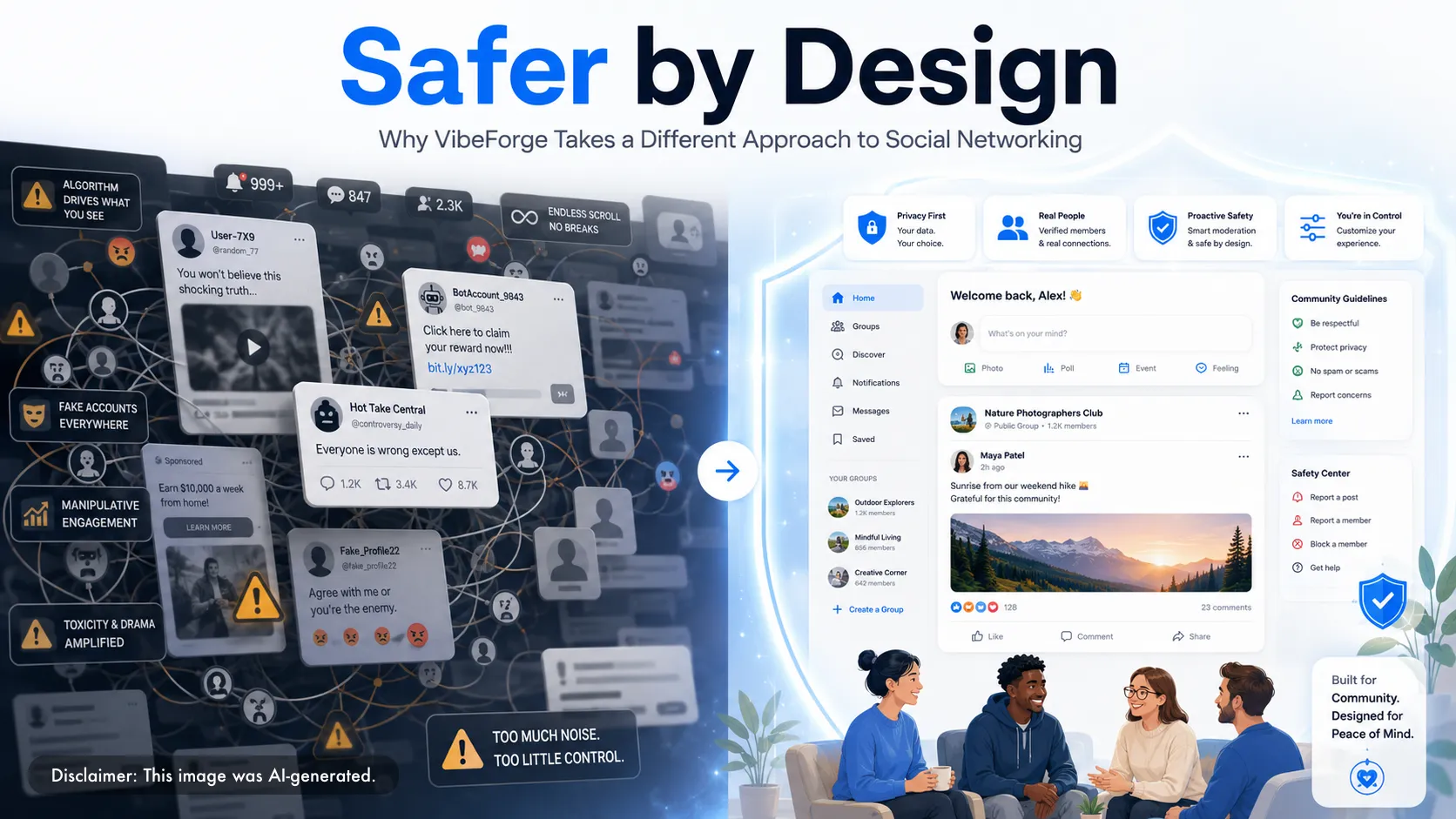
A different approach to social networking—built around people, privacy, community, and control instead of an engagement algorithm.
Social media should connect people. Somewhere along the way, however, many of the biggest platforms became something much more complicated: recommendation engines, advertising systems, behavioral data networks, engagement machines, and enormous moderation operations—all wrapped around what was originally a fairly simple idea: helping people communicate.
VibeForge was built from a different starting point.
We are not going to claim that any social network—including VibeForge—can ever be completely safe. No responsible platform should make that promise. What we can do is make deliberate choices that reduce risk, give people more control, and make safety part of the architecture instead of an afterthought.
Online services face spam, scams, harassment, malicious users, account attacks, misinformation, inappropriate content, and constantly changing security threats. Even the strongest security measures cannot eliminate every risk.
But safety is not simply about whether a website uses HTTPS or has a reporting button.
Safety is also about how a platform is designed. It is about what information the platform collects and uses. It is about what content gets pushed in front of you. It is about whether outrage and engagement determine what you see. It is about how younger members are treated. It is about privacy defaults, unwanted contact, spam, fake accounts, moderation, profile visibility, AI-generated content, and whether users or algorithms ultimately control the experience.
And in many of those areas, VibeForge takes a fundamentally different approach from Facebook.
At a Glance: Two Different Social-Networking Philosophies
| VibeForge | |
| Personalized recommendations shape much of the Home experience | Core social experience is not ranked by an engagement algorithm |
| Engagement signals help determine what content is surfaced | Greater emphasis on deliberate discovery and chosen connections |
| Recommended content can come from outside your existing network | Discovery does not require turning every interaction into a ranking signal |
| Safety systems operate inside a massive advertising and recommendation ecosystem | Safety and privacy are considered while features are being designed |
This is a design-philosophy comparison, not a numerical safety ranking. Facebook provides extensive privacy, moderation, security, and recommendation controls of its own.
The Biggest Difference: VibeForge Isn't Built Around an Engagement Algorithm
One of the most important differences between VibeForge and Facebook is something users may not immediately see.
VibeForge's core social experience is not built around an algorithm deciding what should capture your attention next.
Large social platforms increasingly rely on personalization and recommendation systems to decide what content is most likely to keep people watching, clicking, reacting, commenting, or scrolling. Those systems can be useful for discovery, but they can also create a problem: engagement is not the same thing as well-being.
Something upsetting can be engaging. Something outrageous can be engaging. Something frightening can be engaging. Something divisive can be engaging. Something false can be engaging.
This does not mean Facebook has no safety systems. It does. The larger point is that Facebook's architecture relies heavily on automated systems that continuously decide what deserves your attention.
VibeForge approaches social networking differently. Discovery features can help people find communities, creators, pages, events, and content, but the core experience does not have to turn every interaction into a behavioral signal whose purpose is to rearrange your social world.
You follow people because you chose to follow them.
You join communities because they interest you.
Your attention does not need to be continuously optimized.
That is not merely a user-experience decision. It is a safety decision.
Less Algorithmic Amplification Means Less Opportunity for Harmful Feedback Loops
Anyone who has spent enough time on a large social network has probably experienced some version of this:
- You stop to read one controversial post.
- You see another.
- You click one video.
- Several similar videos appear.
- You react because something makes you angry.
- The system may interpret that reaction as interest.
Before long, your feed can look very different from the one you started with.
Your attention does not need to be constantly optimized.
When a platform is not relentlessly searching for the next thing most likely to trigger engagement, there is less opportunity for an automated system to reinforce anger, obsession, fear, outrage, or unhealthy content-consumption patterns.
VibeForge is designed to feel like a community, not a behavioral experiment.
Your Activity Shouldn't Become the Raw Material for Everything You See
Another major philosophical difference is personalization.
If you tell a social network that you enjoy gardening, it makes sense for it to help you discover a gardening community. But should every click, pause, reaction, conversation, and interaction become another piece of an increasingly detailed model of what an automated system believes will hold your attention?
We don't think that has to be the future of social networking.
VibeForge is designed around people, communities, interests, pages, groups, creators, and deliberate discovery—not the idea that everything you do should continuously refine an invisible profile of what will keep you scrolling.
That gives users something increasingly rare online: room to simply exist without every click needing to become a recommendation signal.
Younger Members Deserve More Than a Checkbox
Protecting younger users has been a major consideration in the development of VibeForge. The platform uses age-aware protections because teenagers should not necessarily be treated exactly the same as adults online.
Younger users may be more likely to:
- Reveal more personal information than they realize.
- Underestimate who can see profile information.
- Accept contact from people they do not actually know.
- Have difficulty recognizing manipulation or grooming behavior.
- Be more vulnerable to harassment and social pressure.
- Share location, school, relationship, or personal information too casually.
VibeForge's approach includes additional protections for minors, age-aware controls, restrictions around sensitive features, and safeguards intended to reduce inappropriate interactions.
The goal is not to prevent younger members from participating. It is to let them participate in an environment that recognizes that age matters when designing online safety.
Privacy Should Be the Starting Point, Not an Advanced Setting
One of the challenges with modern social networking is that privacy settings can become incredibly complicated. A person may technically have control over dozens of settings while still having very little understanding of what another member—or an anonymous visitor—can actually see.
VibeForge takes a more deliberate approach to public and private content. Certain public-facing areas can remain visible enough for visitors to understand what VibeForge offers, while deeper social activity can remain behind authenticated access.
A social network does not have to choose between making everything public and making everything invisible.
Privacy can have layers. A profile can have a public-facing presence without exposing every interaction. A group can be discoverable without exposing everything happening inside it. A platform can promote discovery without turning every member's activity into public content.
That balance is part of building a safer social environment.
Profile Privacy Can Be a Personal-Safety Issue
Privacy is especially important for people whose identity, relationships, location, or personal circumstances could create real-world risk.
For some people, profile privacy settings are simply convenient. For others, they can be much more important.
- Someone may be open about part of their life with friends but not family.
- Someone may live in a community where revealing certain personal information could create consequences.
- Someone may simply not want strangers assembling a detailed picture of their life from profile fields and activity.
Good privacy design recognizes that visibility is not always harmless. VibeForge believes members should have meaningful control over how much of themselves they expose to the wider community.
Fighting Bots, Spam, and Fake Accounts Before They Become Community Members
Some of the most common threats on social media are not dramatic cybersecurity attacks. They are fake accounts, automated registrations, scam messages, phishing attempts, fraudulent promotions, bot-generated comments, and malicious links.
These accounts create more than annoyance. They can be the first step in scams, impersonation attempts, credential theft, financial fraud, or coordinated abuse.
VibeForge uses anti-spam and automated-abuse protections, including CleanTalk, as part of its defense against suspicious registrations and bot activity.
Stopping abusive accounts before they become established members is better than cleaning up the damage afterward.
The Scale of the Problem: Facebook Fake Accounts Actioned
Meta's own enforcement reporting illustrates the enormous scale of fake-account activity Facebook must contend with. These numbers represent accounts Meta took action against; they should not be read as the number of fake accounts users actually encountered.
| Q2 2025 |
|
687 million | |
| Q3 2025 |
|
692 million | |
| Q4 2025 |
|
1.1 billion |
Also notable: Meta reported that 99.9% of the fake accounts it actioned in Q4 2025 were detected proactively before a user reported them.
Source: Meta Community Standards Enforcement reporting, as summarized in Meta's 2026 submission to the UK Parliament's Science, Innovation and Technology Committee. Meta notes that enforcement-action volume can rise or fall for many reasons and should not be treated by itself as a measure of platform safety.
No anti-spam system catches everything. That is why platform safety works best in layers:
- Registration protection
- Automated detection
- Community reporting
- Moderation
- Blocking and privacy controls
- Technical security protections
Safety Isn't Just About Content—It's Also About Commerce
Modern social networks do more than host conversations. They can include marketplaces, fundraising, business tools, creator features, and other forms of commerce. That introduces another category of risk.
If people conduct business through a platform, that platform needs to think about fraud, disputes, abuse, moderation, and ways to address problems when they occur.
Trust is not limited to what appears in the news feed.
AI-Generated Content Requires Transparency
Artificial intelligence has made it easier than ever to generate convincing images, videos, voices, articles, comments, and even entire online identities.
That creates enormous possibilities for creativity. It also creates enormous possibilities for deception.
- A realistic image may depict something that never happened.
- A voice recording may never have been spoken.
- An article may have been generated in seconds.
- A flood of automated comments may create the illusion of public consensus.
People deserve context about what they are looking at.
VibeForge includes AI-content detection and labeling features intended to make synthetic media more transparent and give members more information when evaluating what they encounter.
Moderation Should Protect Participation, Not Just Remove Violations
A healthy community needs rules. But it also needs tools that ordinary members can use before a situation becomes severe enough to require formal moderation.
Members should be able to:
- Block someone
- Mute someone
- Control profile privacy
- Limit visibility
- Report inappropriate behavior
- Manage connections
- Create boundaries around their own experience
Not every negative interaction requires the same response. Sometimes you need a moderator. Sometimes you simply do not want to hear from someone anymore.
Users should have both options.
Smaller Can Actually Be an Advantage
Facebook operates at a scale that is difficult to comprehend. That scale gives Meta enormous resources for cybersecurity, infrastructure, automated detection, research, and moderation.
We are not going to pretend otherwise. VibeForge is not Facebook's size, and claiming that a newer platform has more battle-tested infrastructure simply because it is newer would not be responsible.
But scale also creates challenges. When billions of people, enormous advertising systems, recommendation engines, groups, automated accounts, pages, influencers, businesses, political organizations, scammers, creators, advertisers, and malicious actors coexist inside one ecosystem, moderation becomes extraordinarily complicated.
VibeForge's smaller, community-oriented environment creates an opportunity to build the culture differently.
Growth matters to us—but responsible growth matters more.
VibeForge Doesn't Need to Keep You Angry to Keep You Here
This may ultimately be the most important philosophical difference.
VibeForge does not need every minute of your attention.
We want you to enjoy the platform. We want you to discover communities. We want creators to create. We want conversations to happen. We want people to share photos, posts, blogs, events, ideas, hobbies, projects, videos, causes, businesses, and everyday life.
But we do not believe success should require engineering an endless cycle of emotional stimulation.
Social media does not have to feel like a slot machine.
You should be able to reach the end of what interests you. You should be able to close the app. You should be able to return tomorrow without feeling like an automated system spent the night calculating the perfect combination of outrage, curiosity, fear, entertainment, and controversy needed to pull you back in.
A healthier social platform should respect your attention, not merely capture it.
Facebook Has Safety Systems. This Isn't About Pretending Otherwise.
A fair comparison requires acknowledging something important: Facebook does invest heavily in safety.
Meta operates anti-scam systems, content enforcement systems, account protections, privacy controls, recommendation guidelines, AI-content labeling, advertising controls, and many other security and integrity programs.
The argument for VibeForge is not that Facebook does absolutely nothing about safety. That would be inaccurate.
The argument is that VibeForge begins with a different philosophy.
Facebook has to build safety systems around an enormous advertising, personalization, recommendation, and engagement ecosystem. VibeForge has the opportunity to design the ecosystem itself differently.
Those are not the same thing.
Safety by Design Instead of Safety as an Add-On
The phrase "safety by design" matters. It means asking safety questions while features are being created, rather than only after something goes wrong.
- Should this information be public?
- Should a younger member have access to this feature?
- Should an anonymous visitor be able to see this activity?
- Could this feature enable harassment?
- Could this transaction be abused?
- Could a bot exploit this registration process?
- Could an adult use this feature to contact a minor inappropriately?
- Could AI-generated material mislead someone?
- Could profile information place somebody at risk?
- Could a recommendation system repeatedly amplify harmful material?
These are the kinds of questions that shape VibeForge.
Sometimes the safest feature is an additional security layer. Sometimes it is a privacy setting. Sometimes it is a restriction, warning, moderation tool, or verification step.
And sometimes the safest choice is simply not building the kind of system that creates the problem in the first place.
The Layers of VibeForge Safety
| 1 | Account & Registration Protection Controls intended to reduce suspicious registrations and account abuse. |
| 2 | Bot & Spam Defense CleanTalk and other anti-abuse protections help challenge automated spam and malicious activity. |
| 3 | Age-Aware Protections Additional safeguards and restrictions can apply to younger members. |
| 4 | Privacy & Visibility Controls Members have tools to control what is visible and who can interact with them. |
| 5 | Blocking, Muting & Reporting Members can create boundaries before or alongside formal moderation. |
| 6 | AI Content Transparency AI-content detection and labeling are intended to provide context around synthetic media. |
| 7 | Community Moderation Reports and moderation provide another layer when behavior crosses community standards. |
The point is not that one layer makes VibeForge safe. The point is that safety works best when multiple layers reinforce one another.
More Control. Less Manipulation. Stronger Community.
VibeForge is being built around a few straightforward ideas:
- People should control their social experience.
- Privacy should be understandable.
- Younger members deserve age-appropriate protections.
- Bots and spam should be challenged before they become established.
- Communities should have meaningful moderation tools.
- Sensitive information should not automatically become public information.
- AI-generated material deserves transparency.
- Your social network should not require an engagement algorithm constantly deciding what will keep you watching.
The platform should work for the community—not train the community to work for the platform.
We're Building the Alternative We Wanted to See
VibeForge has been under development for two years because building a social network is about far more than putting profiles and a news feed on a website.
The hard part is deciding what kind of platform you want to become.
We've made our choice.
We want VibeForge to be a place where communities can grow without surrendering control of the experience to an algorithm.
A place where creators can publish without every interaction being reduced to an engagement calculation.
A place where younger members receive additional protections.
A place where privacy is not an afterthought.
A place where spam, bots, fraud, harassment, and malicious behavior are treated as problems to prevent—not simply unavoidable costs of doing business.
A place where technology serves connection rather than manipulating it.
And a place where safety continues evolving as the community grows.
VibeForge Officially Launches September 1, 2026
VibeForge is already open for people who want to explore what we've been building. If you're not ready to register, you can use the Demo Account available from the home page and take a look around first.
Come look around. Explore the communities. See the difference for yourself.
Because social media does not have to choose between connection and safety. It does not have to choose between creativity and privacy. And it does not have to put an algorithm between you and the people you came online to see.
VibeForge is being built to prove there is another way.
Vibe together. Vibe different.
VibeForge — Where Privacy Meets Community and Creativity.
Developed with ❤️ in The Dalles, Oregon.


 English
 Arabic
 French
 Spanish
 Portuguese
 Deutsch
 Dutch
Dutch
 Italiano
 Russian
 Romaian
 Portuguese (Brazil)
 Greek
Greek