

When the White House Decides Who Gets to Ask Questions
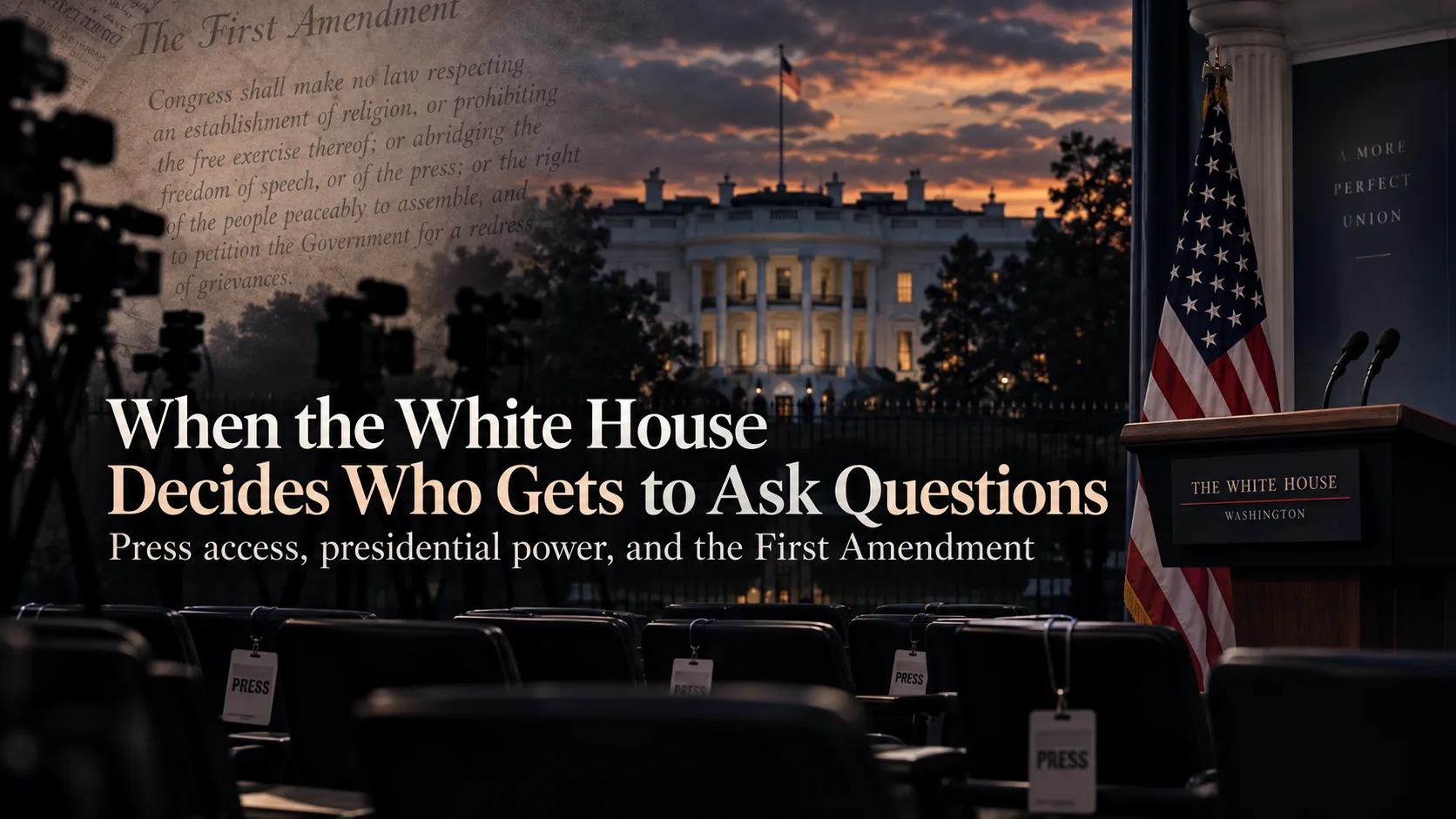
Trump’s White House Press Ban Is About Much More Than CNN, MS NOW and Politico
The real issue is not whether Americans like these news organizations. It is whether the federal government can punish journalists because the president dislikes their reporting.
On September 18, 2026, President Donald Trump announced that CNN, MS NOW and Politico were banned from the White House “effective immediately.”
His stated reason was not a security threat.
It was not a failure to pass Secret Service screening.
It was not a lack of space in the briefing room.
It was not misconduct inside the White House complex.
Trump said the organizations had repeatedly reported what he considers “fake news” and unfavorable coverage of his administration. He also suggested additional news organizations could be banned later.
That distinction matters enormously.
Because while the President of the United States absolutely has the right to criticize CNN, MS NOW, Politico or any other news organization, using government power to punish news organizations because of their reporting raises a fundamentally different question.
This is where a political dispute becomes a First Amendment issue.
And this isn't really about whether someone likes CNN.
It isn't about whether Politico has made mistakes.
It isn't about whether MS NOW has a political perspective.
It is about whether the federal government should be allowed to decide which journalists can physically cover the presidency based upon whether the president approves of their journalism.
That should concern Americans across the political spectrum.
This Is No Longer Just a Threat
There was initially some uncertainty about exactly how Trump's announcement would be implemented.
That uncertainty began disappearing the following day.
On September 19, MS NOW reported that its journalists were actually being denied entry to the White House grounds. White House correspondent Akayla Gardner attempted to enter and found that her badge had been disabled.
According to the Associated Press, the badge was then confiscated.
A photographer was also denied access, although one producer was reportedly allowed onto the grounds.
So this has moved beyond presidential rhetoric. The administration has begun using the machinery of government access to enforce the president's decision.
That is where the constitutional issue becomes considerably more serious.
The President Can Criticize the Press
Before going any further, an important distinction has to be made.
Donald Trump has every right to criticize journalists.
- He can call CNN biased.
- He can say Politico is unfair.
- He can accuse MS NOW of publishing inaccurate stories.
- He can tell Americans not to watch them.
- He can publicly challenge their reporting.
- He can refuse interview requests.
- He can answer another reporter instead.
Presidents do not surrender their own First Amendment rights when they take office.
Nor does freedom of the press mean journalists are immune from criticism.
Quite the opposite.
A genuinely free society allows presidents to criticize journalists and journalists to criticize presidents.
There is a major constitutional difference between:
“CNN is terrible.”
and
“Because CNN's coverage is terrible, its journalists are no longer allowed access to a government press facility available to other journalists.”
The first is criticism.
The second involves government power.
And government power is exactly what the First Amendment restricts.
No, Every Reporter Does Not Have an Automatic Right to Enter the White House
The First Amendment does not mean every journalist in America has a constitutional right to walk through the White House gates.
Obviously not.
The White House is one of the most secure buildings in the world.
The Secret Service can conduct background investigations.
Journalists can be required to pass security screening.
Physical access can be limited.
Some meetings can be closed.
Classified discussions can remain classified.
A president can hold private meetings without inviting reporters.
There is no constitutional requirement that every reporter be admitted to every presidential event.
But that's not where the strongest constitutional argument against this ban comes from.
The problem is what happens after the government creates an official press-access system and makes access generally available to qualifying journalists.
At that point, the government does not have unlimited discretion to use access as a political reward.
A Court Answered This Question Nearly 50 Years Ago
One of the most important cases involving White House press credentials is Sherrill v. Knight, decided by the U.S. Court of Appeals for the D.C. Circuit in 1977.
The court was careful.
It did not say the White House must maintain press facilities.
It did not declare that every journalist must receive a credential.
Instead, the court recognized something more specific.
Once the White House establishes press facilities and makes them generally available to bona fide journalists, denial of access implicates First Amendment interests and cannot simply occur through an arbitrary government decision.
The case also required procedural protections when permanent White House press credentials were denied.
That basic principle has remained extraordinarily important in later White House access disputes.
The government can establish rules.
What it cannot do so easily is establish rules that amount to:
The Central Constitutional Issue Is Viewpoint Discrimination
This is probably the single most important phrase in the entire controversy:
The First Amendment places particularly strong restrictions on government efforts to penalize speech because officials dislike the speaker's viewpoint.
Imagine three newspapers.
One constantly praises the president.
One generally reports neutrally.
One constantly criticizes him.
If all three otherwise meet the government's neutral credentialing requirements, a government rule saying:
“The first two may enter, but the critical newspaper may not because we dislike its coverage”
creates an obvious constitutional problem.
That is very different from saying:
“None of you may enter this particular room because it only has eight seats.”
The first rule concerns viewpoint.
The second concerns capacity.
Likewise:
“You cannot enter because you refused required security screening”
is fundamentally different from:
“You cannot enter because we dislike your stories.”
The constitutional distinction is enormous.
Trump Has Already Been in a Very Similar Fight
This administration has already been involved in a remarkably similar First Amendment dispute.
In 2025, the Trump White House restricted the Associated Press from certain presidential access after the AP declined to universally adopt the administration's preferred name, “Gulf of America,” and continued using “Gulf of Mexico” in its editorial style.
That case went to federal court.
The court made an important distinction.
The Associated Press did not have an automatic constitutional right to attend every presidential event.
But when the administration opened events to a group of journalists, the government could not constitutionally disadvantage the AP merely because officials disliked the news organization's editorial choice.
The court found the AP likely to succeed on its First Amendment claims involving viewpoint discrimination and retaliation.
That case matters now because the underlying issue is strikingly similar:
Can an administration open government press access to journalists generally and then exclude particular organizations because it dislikes their editorial decisions?
That is exactly the kind of issue courts have treated with constitutional suspicion.
This Is Bigger Than Three Media Companies
Here's where people need to separate their personal opinions about journalism from the constitutional principle involved.
Maybe you don't watch CNN.
Maybe you can't stand MS NOW.
Maybe you've never read Politico in your life.
That doesn't really matter.
Constitutional protections are rarely tested using people everyone likes.
Rights matter precisely because they protect people and organizations government officials dislike.
If a constitutional principle only applies to friendly speakers, it isn't much of a constitutional principle.
So consider the rule being established here rather than the organizations involved.
If a Republican president may exclude a liberal or center-left news organization because he believes its coverage is dishonest, what prevents a future Democratic president from banning conservative organizations for the same stated reason?
Imagine a president saying:
“Fox News repeatedly lies about my administration. Effective immediately, Fox News is banned from the White House.”
“Newsmax is spreading misinformation. Its reporters are no longer admitted.”
“The Wall Street Journal editorial page is unfair to me, so its reporters lose access.”
The constitutional principle has to remain the same regardless of whether someone approves of the outlet.
That is precisely why the First Amendment exists.
Presidents Should Not Decide Which Journalism Is “Real Journalism”
There is also a deeper problem with using “fake news” as the standard for White House access.
Who decides what qualifies as fake?
The president?
The White House communications director?
The press secretary?
A political appointee?
Imagine giving every future administration that authority.
Republicans could declare liberal reporting fake.
Democrats could declare conservative reporting misinformation.
Each successive administration could create its own unofficial list of approved journalism.
At that point, White House access could gradually become dependent upon political acceptability rather than neutral journalistic qualifications.
That isn't merely a media problem.
That becomes a government-information problem.
The Most Dangerous Effect May Be the One You Never See
There is another consequence that is harder to measure.
Self-censorship.
Suppose you are a reporter or an editor.
You know three major organizations have just been excluded from White House access because the president publicly objected to their coverage.
Now your organization obtains a story that is extremely damaging to the administration.
Before publishing, someone in the newsroom may begin wondering:
“Will we lose our credentials too?”
That thought alone changes journalism.
Maybe the headline becomes softer.
Maybe the story gets delayed.
Maybe an aggressive question doesn't get asked.
Maybe an investigation suddenly requires another six weeks of review.
Maybe a publisher worries about losing interviews, pool access or White House credentials.
Government does not necessarily have to formally censor anyone if journalists begin censoring themselves out of fear of government retaliation.
That phenomenon is commonly described as a chilling effect.
And chilling effects are one reason courts take government retaliation for protected expression seriously.
What Happens When Access Becomes a Reward?
Think about where this could eventually lead.
A friendly reporter gets regular access.
A neutral reporter gets occasional access.
A hostile reporter gets none.
Now every journalist covering the White House understands the incentive structure.
Praise gets access.
Aggressive scrutiny risks exclusion.
Even if nobody explicitly says those words, the message is obvious.
Over time, a press corps operating under that incentive structure becomes less capable of functioning independently.
And Americans receive less reliable information about what their government is doing.
The government effectively begins shaping the composition of the group responsible for scrutinizing it.
That should make people uncomfortable regardless of which political party controls the White House.
White House Reporting Is Not Just Political Entertainment
Some people may understandably wonder why any of this affects their everyday lives.
Because White House journalists don't spend all day asking questions about political drama.
They ask questions about:
- Wars
- Troop deployments
- Taxes
- Tariffs
- Social Security
- Medicare
- Medicaid
- Federal disaster response
- Immigration enforcement
- Inflation
- Energy prices
- Food prices
- Unemployment
- Criminal investigations
- Public health
- Prescription drugs
- Veterans
- Education
- Civil rights
- Foreign governments
- Federal spending
- Corruption
- Executive orders
Those issues affect ordinary Americans directly.
If journalists become afraid to aggressively question government officials because access can disappear after unfavorable coverage, the people who ultimately lose information are not journalists.
They're citizens.
The Judicial System Now Becomes Extremely Important
If CNN, MS NOW, Politico or affected journalists challenge these bans, federal courts may eventually have to determine whether the administration crossed that line.
And that is exactly what courts are supposed to do.
The American constitutional system deliberately divides power.
The executive branch does not get to decide for itself whether every executive action is constitutional.
Courts review government conduct.
That principle is particularly important when the government itself is accused of violating constitutional rights.
A lawsuit could potentially raise questions involving:
- First Amendment freedom of the press
- First Amendment retaliation
- Viewpoint discrimination
- Fifth Amendment due process
- White House credentialing procedures
- Legitimate presidential security authority
- Government control over limited-access press facilities
Those questions would depend upon the exact mechanics of the ban, how broadly it is enforced, what procedures exist and whether neutral standards are being applied.
That's why it would be premature to declare exactly how every court will ultimately rule.
But it is equally wrong to pretend there is no serious constitutional issue.
There clearly is.
The First Amendment Protects Conservatives Too
Conservatives should be especially cautious about establishing a precedent that allows a president to determine which news organizations deserve access based upon whether their coverage is truthful.
Because government power changes hands.
Imagine this exact authority being used someday against:
- Fox News
- Newsmax
- The Daily Caller
- The Washington Examiner
- Breitbart
- The New York Post
- A conservative podcast network
- A Christian news organization
- An independent journalist investigating a Democratic president
The constitutional protection has to work both directions.
Otherwise it isn't constitutional protection. It's merely partisan protection.
The First Amendment Was Not Written to Make Presidents Comfortable
No president enjoys hostile coverage.
George Washington didn't.
John Adams certainly didn't.
Abraham Lincoln didn't.
Richard Nixon didn't.
Barack Obama didn't.
Joe Biden didn't.
Donald Trump clearly doesn't.
Presidents are human beings.
They get angry when they believe journalists treat them unfairly.
But the Constitution wasn't written around presidential comfort.
It was written around limiting governmental power.
The First Amendment does not promise the government a cooperative press corps.
It protects the existence of an independent one.
Journalism Is Supposed to Be Annoying Sometimes
A functioning press should occasionally irritate whoever holds power.
That does not mean every hostile story is good journalism.
It doesn't mean every reporter is unbiased.
It doesn't mean every accusation is true.
But if reporters never make politicians uncomfortable, they're probably not doing much investigative journalism.
The White House press corps isn't supposed to function as the president's communications department.
The administration already has one of those.
Journalists are supposed to ask the questions the communications department would rather not answer.
This Is Really About Who Gets to Watch the Government
Strip away every network name.
Strip away Trump's personality.
Strip away partisan politics.
The central issue becomes remarkably simple.
The United States government is extraordinarily powerful.
The president commands the military.
The executive branch controls enormous federal agencies.
It prosecutes crimes.
It conducts surveillance under legal authority.
It negotiates with foreign governments.
It collects taxes.
It administers immigration laws.
It issues regulations.
It spends enormous amounts of public money.
Someone needs to watch the people exercising that power.
Congress does.
Courts do.
Inspectors general do.
Whistleblowers sometimes do.
And journalists do.
None of those systems is perfect.
But eliminating independent scrutiny doesn't make government better.
It makes government easier to hide.
The Real First Amendment Question
There will likely be plenty of arguments over terminology.
Is it technically a ban?
Is it suspension of credentials?
Does it apply to the grounds?
The briefing room?
The press pool?
Presidential events?
Those details will matter legally.
But the broader constitutional question is much simpler:
Can the President of the United States use official government access to punish news organizations because he dislikes their coverage?
Based upon decades of First Amendment doctrine and White House access litigation, that proposition faces serious constitutional obstacles.
The government can regulate access.
It can protect the president.
It can impose neutral credentialing rules.
It can limit space.
It can close certain events.
What it cannot easily do is turn official access into a political loyalty test.
You Don't Have to Defend CNN to Defend the Constitution
This may be the most important point of all.
Defending the constitutional principle involved here does not require anyone to defend CNN's journalism.
You don't have to watch MS NOW.
You don't have to subscribe to Politico.
You don't even have to believe these organizations are fair.
You can criticize them tomorrow.
The Constitution does not require admiration for the people whose rights it protects.
Sometimes it requires exactly the opposite.
It asks whether we're willing to defend constitutional limits when the people affected are people we dislike.
That is the harder test.
And it is the one that actually matters.
Today It Is CNN, MS NOW and Politico
Today the organizations are CNN, MS NOW and Politico.
Tomorrow they could be Fox News, Newsmax and The Wall Street Journal.
The administration after that may target someone else.
That is why the precedent matters more than the personalities.
Presidents come and go.
Political parties win and lose.
News organizations rise and disappear.
But constitutional powers, once accepted, have an unfortunate tendency to remain available for whoever comes next.
The Bottom Line
Donald Trump is free to call CNN, MS NOW and Politico wrong. He is free to criticize them publicly. He is free to challenge their reporting. They are free to answer him. And Americans are free to decide whom they believe.
The real constitutional question is whether the people who exercise government power also get to choose which critics are allowed in the room to watch them exercise it.
```




 English
 Arabic
 French
 Spanish
 Portuguese
 Turkish
 Dutch
Dutch
 Italiano
 Russian
 Romaian
 Portuguese (Brazil)
 Greek
Greek