


 Help Center
 Vibeforge: End User Guide
WWW.404MEDIA.CO
I Almost Lost My Mind in the Bridal Algorithm
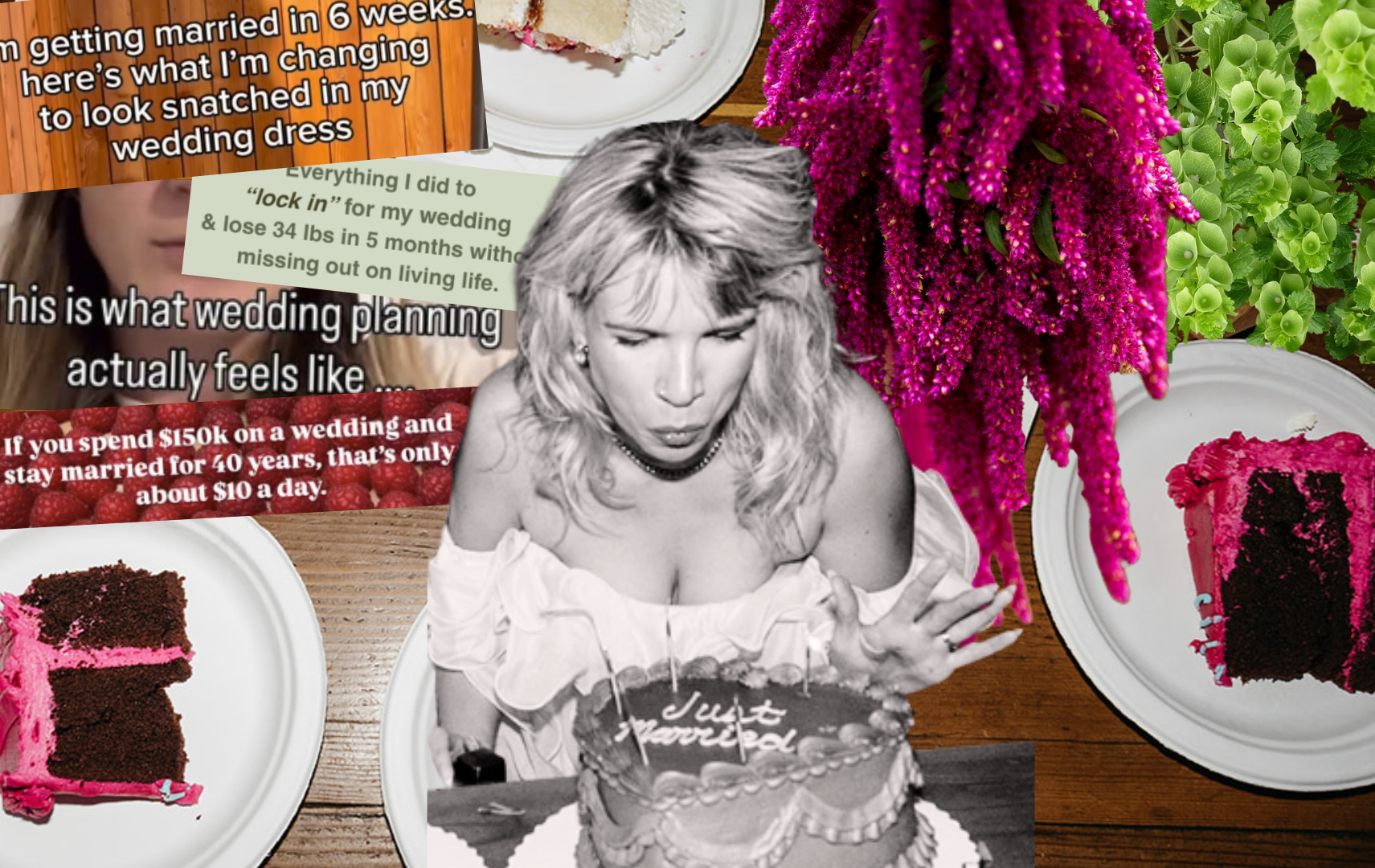
I thought I would be a cool bride. I believed this because I never dreamed of my own wedding. When other girls daydreamed aloud about riding down the aisle on a pony, or gracefully officiated the union of a Princess Diana Beanie Baby and a Hot Wheels truck, I came up blank. Despite a constant stream of 90s media featuring transformative white dresses, there was nothing my imagination could conjure for it. I was busy scheduling meetings on my toy Palm Pilot. This was fine until 30 years later, when my now-husband asked me what I wanted for our own wedding, and I had nothing. After years of watching friends plan weddings, I only had one preference for the day: I didnt want to feel stressed out.There are a few industries that prey on emotion particularly brazenly. The funeral industry is one. The wedding industry is another. I knew this going in. I thought I could defeat hundreds of years of socially ingrained pressure backed by a multi-billion dollar consumer machine. No problem.What I did not account forshamefully, considering how much time I spend thinking and writing about technology in my professional lifewas that in the more than three decades Id spent building a resistance to deeply gendered expectations on my existence, that machine was perfecting the art of making me feel weird, broke, and ugly, and I wouldnt recognize what was happening until I was deep in it. Im talking about the wedding planning algorithm. When Lillie and her fiance Morgan got engaged, Lillie told me she saw the difference in her social media feeds the moment she texted her friends the news. (Theyre using first names only in this story for their privacy.) Immediately, all of my social media was just flooded, she told me in a phone call. And I think at the beginning it was all just so shiny and new. I was like, This is so awesome. So I did kind of consume a lot of bridal media pretty strongly out of the gate, because I didn't quite realize yet how much it was going to take over every single one of my social media apps.We talk a lot here on 404 Media about the algorithm. Usually we're referring to either Instagram Reels or Tiktok. Part of the reason we discuss and dissect it so frequently is because if you're not careful, the algorithmthe spew of content these apps automatically show you based on your past viewing habits, data from other apps, or what the app thinks youre interested inbecomes a mirror of your mind; this is dangerous territory considering it's easy to manipulate by people, brands, networks and corporations with perverse incentives.Some of this actually seems, and sometimes is, helpful at first. The design pattern of infinite scrolling relies on a variable reward system to be effective and truly endless. The next thing you see in your feed might be the exact nugget of wisdom, life hack, or listicle you needed to make your life better, or, in this case, your wedding flawless. But youll never know unless you keep scrolling through the next hundred useless or actively brainrotting videos.Like Lillie, the moment I got engaged and started Googling wedding dresses and venues was the moment my entire social media experience shifted into the Bride Algo. Every Reel and Tiktok, and I do mean every single post, contained something new I needed to change about myself: Everything I did to lock in for my wedding & lose 34 lbs in 5 months without missing out on living life. If you spend $150k on a wedding and stay married for 40 years, that's only about $10 a day. Not bad for one of the best days of your life.What I will NOT be doing as a 2026 bride.Bridal Breakdown PSA to 2026 Brides.POV: Youre not fat, youre just puffy.25 Things Guests Secretly Hate About WeddingsLEAVE THAT MAN AT THE ALTARJournalist CT Jones calls the effect this content has on even the most level-headed people wedding brain. They recently wrote: Theres this fog around my head that I cant seem to shake when it comes to this event. My TikTok algorithm tells me every three swipes about the biggest mistakes people make that ruin their special days.Today's authority on weddings is Vogue, and in January 2020, Vogue correctly identified that social media was changing everything about how couples plan weddings. Women of the 2010s became a lot more knowledgeable thanks to social media, designer Danielle Frankel told the magazine. They began seeing not just their friends getting married, but aspirational brides they follow on Instagram. Theres something kind of cool about researching through real people and their experiences, and the ability to share stories through a social platform. In the six years that followed, this chipper assessment of there being something kind of cool about literal celebrity weddings does not age well. Being an influencer or content creator became one of the dwindling few ways for anyone in a creative field to make a living, a situation solidified by a tanked economy, a never-ending housing crisis, widespread unemployment, and AI gutting of a variety of fields.Fast forward to earlier this month, New York magazine published a story about the behind-the-scenes process that decides whose wedding makes it into Vogue, and what happens when they dont. One woman in the fashion industry had a breakdown after Vogue turned her down, journalist Charlotte Klein wrote, adding that the jilted bride went to trauma rehab after. But the real crux of the issuehow multi-million dollar Vogue weddings, most of which are not celebrities but are parties thrown by total unknowns, are perceived, consumed, and rely on real, normal peoples attentioncomes at the very end of the story, in a quote from a mysteriously anonymous fashion editor: A wedding is a lot of work. Its a full production and youre spending months on it and youre designing itits a creative achievement in a way. If someone puts on a play or does an art installation, they get press and attention for it. And its like, Well, I did all this stuff for my wedding. Where is my round of applause?That editor is talking about the Beckhams of the world, and the reality TV stars, and the old, old money Beltway normies. But theyre also talking to, and about, the rest of us.This is all so much insidious than it used to be. While the lifestyles of the rich and famous used to be reserved for magazines and Hollywood, were all swimming in the same algorithmic ocean now. Today, Instagram encourages people to treat life itself like a wedding-like a production engineered to be witnessed and admired by an audience, Jia Tolentino wrote in her 2019 book of essays Trick Mirror. It has become common for people, especially women, to interact with themselves as if they were famous all the time. Under these circumstances, the vision of the bride as celebrity princess has hardened into something like a rule. Expectations of bridal beauty have collided with the wellness industry and produced a massive dark star of obligation.I know that Im not alone in the Weddingtok and the Bridal Algo because people have started making videos mocking the content thats stressing us all out. If you feel calm, its probably because youre forgetting something, one planner says in a satirical video. The comments on these send-up videos reveal hundreds of women saying theyre stressed beyond belief, losing their minds, or otherwise crashing out. A comment on another such video: Me locking in because Im getting married next month and I fucking hate myself is literally my entire personality. On another: Pulling my hair out and screaming and cant wait to disappear. Looking back, the moment I first heard the phrase cake inspo board feels like foreshadowing. I'd emailed a handful of bakeries and filled out a dozen inquiry forms at that point in the planning process. Because of competitiveness among vendors about rates and offerings (or possibly because some evil McKinsey for Weddings-type MBA entity decided this is a useful lead generation sales flow), every piece of information has to come directly from a vendor these days and is almost never listed on their websites publicly. Its acquired by prospective clients, who blast 400 inquiries to their contact forms, some of them requiring multiple choice quizzes about the budget, timeline, wedding day vibe and personal social media handles. A few bakers got back to me with quotes for simple cakes. One asked for my mood board. For a cake? Like... flavors? I felt like Id missed a step going down the stairs. I didn't have a vision board for the cake. I needed a vision board for the cake.Prior to planning a wedding, I hadnt used Pinterest since 2008. When I started using it again after several vendors asked me for it, I felt a sugary thrill at pinning a disjointed collage of flowers, dresses, and other things Id only describe as moon-landing-aspirational boards. Pinterest, meanwhile, is increasingly a minefield of AI slop, and has been for a while, with AI-generated makeup inspiration photos and dresses, which makes the process feel more confusing and unachievable.Alongside the thickly-iced and piped vintage triple-layer cakes is thinspo content, in the form of viral walking routines, the Gabby George arm workouts, and ads for ordering a GLP-1 online. Thinspo content is all over Pinterest and other social media platforms.On Pinterest, every single photo is bones. Like, I can see clavicles. I can see sternums. I can see collarbones, Lillie said. Especially with the bridal outfits. Once she starts feeling herself spending too much time looking through this kind of content, she takes a break."I'm like, okay, you know what? At least it's not just me, at least I'm not the only one who's like, This is crazy.I asked my friend Kelli Sullivan, whose objectively stunning wedding I attended in 2025, if shed felt any of these anxieties while planning hers. I feel like social media especially in recent years has gone so overboard with talking about and showcasing weddings, and particularly in a super influencer and curated style, that even subliminally influenced my own decisions when planning, she said.I dont feel like social media gave me direct pressure when it came to planning and decision making, but it definitely influenced my wedding, Kelli said. But it wasnt all bad for her, necessarily. I really loved immersing myself in that niche of social media and was inspired by Pinterest, Instagram and TikTok wedding ideas that helped shape many of my decisions and ideas I never would have really even considered as a possibility otherwise, she said. I also really appreciated insights from other brides and hearing their horror stories and similar struggles made me feel less alone when things felt heavy in planning.Lillie said the same. That is just the beauty of social media, sometimes, to just not feel alone. That has been really, really helpful for me, she said. But I'm like, okay, you know what? At least it's not just me, at least I'm not the only one who's like, This is crazy.Attending Kellis wedding, and all the other beautiful but vastly different weddings my friends have planned over the years, felt essential to understanding the many unspoken rules around ceremony, etiquette, and tradition, and all the ways these rules should be broken. But Lillie is the first of her friends to have a wedding. I will kind of be the guinea pig for all of my friends, I guess, to look at my wedding and be like, this is how Lillie did it, she said. Thats also kind of been a lot of pressure. It's hard.Adding to that pressure, she and Morgan are navigating these expectations as a lesbian couple in Idaho, and where they live skews heavily Mormon, conservative, and Christian. They use social media to vet vendors friendliness toward queer couples before contacting them, scanning Facebook and Instagram pages for signs of intolerance or hate. Lillie calls this being on the lookout.Are these people that I want to interact with? How are they going to treat me? Am I going to be treated differently? I have to get some stuff altered for the boys suits, and wed gotten in contact with a local seamstress up here, and I'm like, scrolling through her Facebook to see how she feels about me. And that's just a tiring thing to do. But its for my own safety. I don't want to go into these people's houses if its not going to be somewhere safe for me. That sometimes sounds really dramatic, but it's not. It just kind of casts a sort of shadow over everything, Lillie explained. This is supposed to be just such a joyous time of our life.Almost all of the most viral wedding planning content on social media is aggressively heteronormativea reflection of an industry struggling to keep up, and attitudes toward queer relationships and marriage in this country that are painfully, dangerously outdated. Lillie tells vendors that she and her fiance are both women, and they still ask her who the groom is. They routinely ask her, Whos going to be the boy? Meanwhile, Tiktok tells us a silk scarf basque waist dress and a sparkler exit is the real sin. During my own planning, guests and vendors frequently asked me what our colors were. I didn't want to have specific colors, but the algorithm told me that even multicolor weddings are on-trend (derogatory), part of a wildflower fad of eclecticism. The algo also told me, over and over, that no matter what else I did, there was one combination to avoid lest I become a cringe dated chopped unc chud of a bride: chartreuse and burgundy.One of the planning tasks I truly enjoyed was picking out and arranging my own (minimal) florals. If the wedding youre planning is at a venue thats not all-inclusivemeaning, its on you to supply everything from the chairs and linens to the sound system, florals, food, desert, on and ona lot of the process is emails and payment portals. I wanted to choose and assemble my own flowers for this reason: I needed to do something with my hands, finally, that brings me joy.My fianc and I went to a wholesale flower market two days before our wedding and picked bunches. And ultimately, when I got to the flower market with no plan for my bouquet other than to choose what called to me, I ended up with a swaggy handful of hanging burgundy amaranthus stems and bright lime Bells-of-Ireland. Now everyone would know I got married sometime between 2025-2026.This fear of being dated is a real joy killer, and a heavily-pushed narrative on the bridal algo right now. I love Basque waisted dresses and find them reliably flattering for my body shape, but #2026Bride influencers deemed them inexplicably cringe at some point in the last year, so my attraction to them soured, and finding a dress became a nightmare of rush shipping, returns and restocking fees. (While writing this story, InStyle published a piece that could only be made in that lab: a series of collage illustrations imagining Taylor Swift in wedding dresses, including one captioned If youre on #WeddingTok in 2026 like I am, youll know that the patron saint of basic bitches, Taylor Swift, is a basque-waist dress, burgundy-and-chartreuse color palette girl.)The fact that I can be swayed at all by what an internet person thinks, as a 36 year old with decades of being socially weird under my belt, disturbs me. I know that everything about what we do, wear, say, and choose is destined to be dated someday because we exist in a specific time. And yet, realizing when I got back with my bouquet and 15 pounds of freshly cut florals that Id still somehow broken the years biggest, most made up mean-girl rule made me feel like an uncool little kid again.In the car on the way back from the flower market, I bemoaned all of these things to my fianc, who endured our apartment transforming into a shipping warehouse for weeks. He asked if it's a comparison is the thief of joy type-thing. It is that, but the comparison is no longer with some girl you went to high school with. Rather, it's an entire universe of options, budgets, opinions, and salespeople. In the scroll, its hard to tell the difference between a wedding real people got married at, and a photo spread that's meant to highlight a set of vendors or brands. Twenty years ago, an average couple might have had a wedding in their backyard or at the firehouse with catering, but surely they werent this stressed about tablescapes or cake inspo Pinterest boards."Most couples arent models, most budgets arent six figures, and most wedding days dont unfold under perfect conditions."People are getting wise to this. And theres one type of wedding that I scrolled past over and over again before I realized they were all entirely staged: styled shoots. Styled shoots are a common cheat. Its kind of unethical imo. Once you know what to look out for, its pretty obvious, Lana Dubkova, a documentary-style event and brand photographer, recently posted on X. Lanas been a photographer for a decade but started doing weddings full-time in 2023. In a styled shoot, photographers, confectioners, designers, florists, venues, stylists, and the rest of the wedding vendor galaxy come together, often with professional models to serve as the bride, groom and guests, to display their wares in an editorial setting. These arent real weddings, but are meant to advertise their work to real couples and planners. And they are impacting real couples wedding day wants.Lana told me in an email that although her clients typically come to her for her own candid style, she often needs to gently recalibrate their expectations. A common tension is that couples want both a highly immersive experience and an extensive set of posed, editorial images... without realizing those require time! A wedding day is finite, and every decision is a tradeoff: more time spent on photos often means less time spent with guests, she said. Most of these expectations come from social media, where timelines, budgets, and logistics are invisible. Whats presented as effortless is usually highly produced, and that disconnect can create unnecessary pressure.She doesnt believe styled shoots are all bad. They do serve a purpose for vendors portfolios. There's a case to be made that maybe you're not getting hired for the type of weddings you would like to photograph and so you invest the money into a styled shoot to be able to display the style of wedding you want to be hired for in your portfolio, she said. Takes money to make money etc. But let's say you're a client looking to hire a photographer for a wedding. How would you feel if you found out the photographer you hired had ONLY styled shoots in their portfolio and had never actually shot a real wedding before? I imagine you'd want to know that ahead of time.Styled shoots become problematic when theyre presented without context, she said. A styled shoot is, by definition, a controlled environment: professional models, ideal lighting, high-end venues, curated florals, and unlimited time. Real weddings are the opposite: dynamic, time-constrained, and emotionally complex. Most couples arent models, most budgets arent six figures, and most wedding days dont unfold under perfect conditions. A photographers ability to work quickly, adapt to changing light, and make people feel comfortable matters far more than their ability to create a perfect image in a controlled setting.If youre not planning a wedding or havent in the last three years or so, you might not be familiar with any of the content Ive described so far. But this is the insidious nature of the algorithm. No one else is seeing yours. No one attending my wedding (except for others who were also recently married and are online) knew or cared that chartreuse and burgundy have been deemed cliche. They just liked the bouquet and thought it was pretty. And if they knew, they didnt say it to my face, because talking about the internet in real life is absurd.If social media didnt exist or especially exist in the way it does with the curation (for weddings in particular) I probably would have done things way differently and maybe simpler, Kelli told me. Having a universe of options shown constantly online did give decision fatigue and also a pressure to have everything be aesthetic, especially with the knowledge that what we will share from the wedding will be perceived by others on social media.If I knew then what I know now, would I have planned a smaller wedding? Would I have probably eloped? Yes, Lillie told me. Do I still have, like, $8,000 in nonrefundable deposits down? Yes.The things I remember about my friends weddings are not their tablescapes or whether they featured some forbidden color combination, and I didnt make lists of things that made me secretly hate them. I remember, most of all, the moments around the weddings: meeting at a cobblestone street cafe the night before for warm Kronenbourgs, pouring mimosas on a moving bus in the morning, gluing an eyelash back on in a beach bathroom, fireworks shows both planned and unplanned, watching my newlywed friends sing and dance and feeling grateful to witness it all. The million tiny moments I remember from my own wedding are part of a different galaxy than all the shit my algorithm told me to worry about.In the end, I didnt make a cake vision board. I picked up cakes at the grocery store two days before the wedding, and in the heat of the evening, they melted into piles of buttercream goo before we could cut them fast enough. While we struggled to light candles, they toppled into heaps of pink and white icing and we just laughed.Now that Im several weeks beyond my own wedding, my algorithm has moved on, almost entirely free of bridal content of any kind. It has realized, or decided, that I have no need for it anymore, and must push me on my way to the next Arbitrary Human Milestone. Its the exact same type of pseudo-authority influencers and ragebait disguised as wisdom, just for another industry the profit-making machine has been waiting eons to target me with: babies.Tip Jar
0 Reacties
0 aandelen
3 Views
0 voorbeeld

 English
 Arabic
 French
 Spanish
 Portuguese
 Deutsch
 Turkish
 Italiano
 Russian
 Romaian
 Portuguese (Brazil)
 Greek
Greek